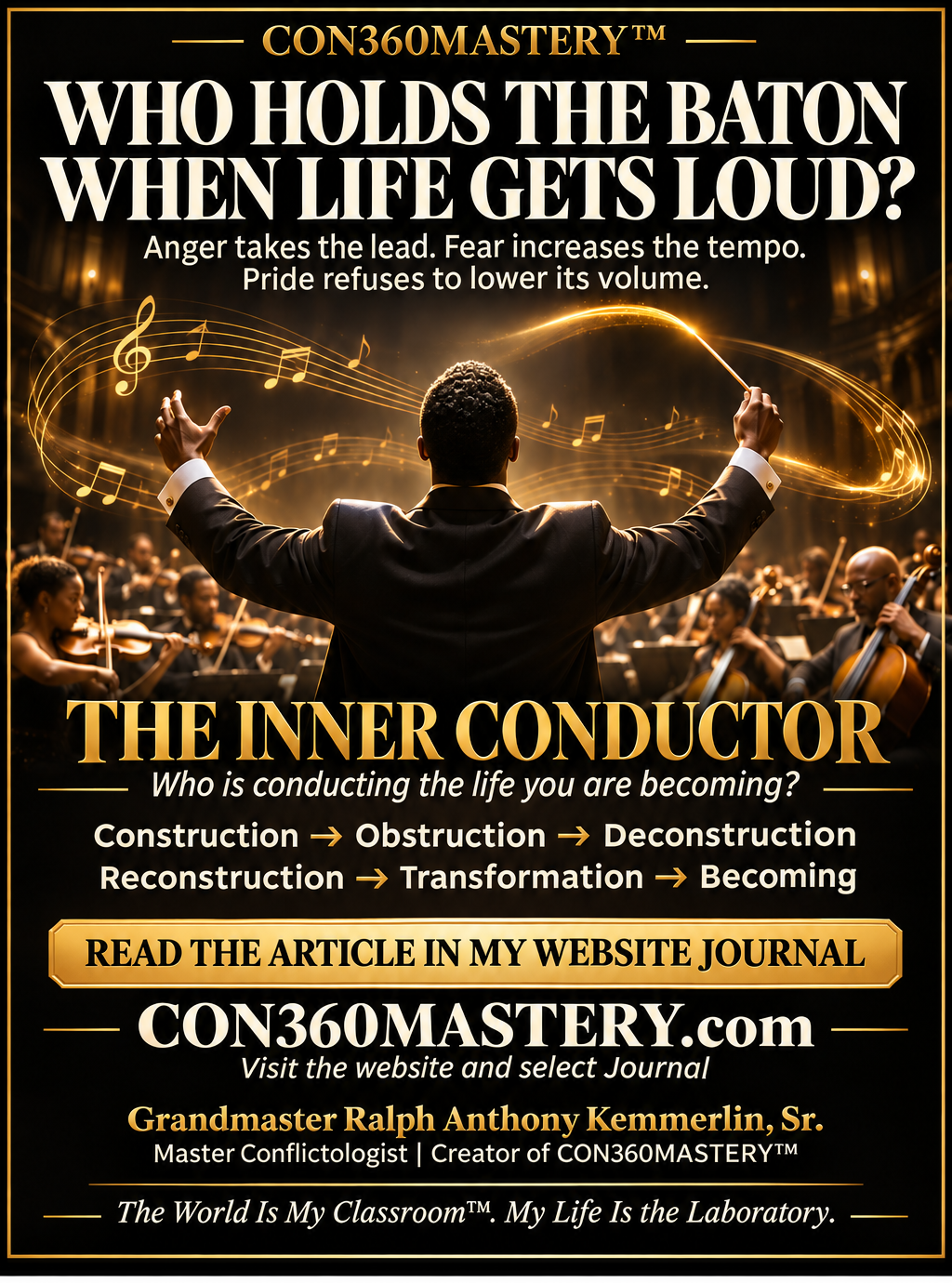
Construction → Obstruction → Deconstruction → Reconstruction → Transformation → Becoming
Imagine an orchestra taking its place before a performance. The chairs are occupied. The instruments are ready. Every musician brings preparation, experience, and a particular responsibility. Then the conductor steps forward. A hand rises. Eyes become attentive. There is a moment of preparation, and then the music begins. Before a single note reaches the audience, something consequential has already happened: attention has been gathered, an intention has been communicated, and a beginning has been prepared.
Now imagine that same orchestra with every instrument demanding to be heard at once. The trumpet refuses to soften. The percussion accelerates whenever it becomes excited. The violin interprets every pause as rejection. The cello continues playing a passage that everyone else has already finished. There is talent in the room. There is energy in the room. There may even be good intentions in the room. But the performance suffers because those capacities are moving without sufficient coordination. How many human lives resemble that rehearsal?
A person can possess intelligence, experience, education, faith, and professional standing while still struggling to coordinate what happens inside when life becomes difficult. Anger enters before understanding. Fear increases the tempo. Pride refuses to lower its volume. An old injury continues playing beneath a new conversation. The mouth begins a performance that judgment has not yet approved. By the time we recognize what happened, someone else has already experienced the consequences. I want to bring you a question that reaches beyond music: Who is conducting the life you are becoming?
I use the orchestra as a teaching metaphor—a familiar experience through which we can examine human conduct. A person is more complex than an orchestra, and no metaphor explains the whole human being. But this one gives us a useful classroom. It allows us to see timing, preparation, attention, expression, repetition, listening, and coordination in motion. Through CON360MASTERY™, I connect those observations to the Architecture Spine of Human Becoming™: Construction, Obstruction, Deconstruction, Reconstruction, Transformation, and Becoming.
Construction: Who Wrote the First Score?
Before musicians perform a composition, there is a score: the written arrangement that tells them what to play and how their parts relate. In human life, many of our earliest arrangements begin before we can examine them. We learn from what people repeat, what they reward, what they punish, what they tolerate, and what they demonstrate under pressure.
Some of us learned that strength meant remaining calm. Others learned that strength meant making someone else afraid. Some learned that disagreement could open a conversation. Others learned that disagreement was the beginning of danger. Some learned that silence offered room for thought. Others learned that silence meant punishment was approaching.
Those lessons can travel with us into adulthood. They can enter marriages, classrooms, boardrooms, athletic programs, houses of worship, and public service. A person may leave the childhood house while continuing to carry its emotional arrangements. That is Human Construction: examining how experience helped form the patterns through which we interpret and respond to life.
Imagine a supervisor who grew up around loud arguments. During a staff meeting, an employee questions a decision. The employee intends to clarify a problem. The supervisor experiences the question as a challenge to authority. His voice hardens. His shoulders rise. He interrupts. Before the employee finishes explaining, the supervisor is responding to a meaning that has not been established. The question belongs to the present. Part of his interpretation may belong to the past.
My teaching begins with Investigative Curiosity Before Judgment™. What happened? What meaning did I attach to it? What evidence supports that meaning? What else could explain what I observed? These questions help us examine the score before we insist that everyone around us perform it. We cannot choose our earliest construction. We can develop greater responsibility for what we continue rehearsing.
Obstruction: What Is Interfering With the Rehearsal?
A rehearsal can be interrupted by an unavailable instrument, an unclear direction, or a musician who refuses to listen. The difficulty must be identified before the response can fit it. Human Obstruction asks what is impeding a worthwhile purpose, including external conditions and our own habits.
For the supervisor, the obstacle may include a crowded meeting agenda, an unclear instruction, and the urge to treat every question as resistance. Preparation means anticipating a foreseeable difficulty without assuming that every employee intends harm. Some barriers call for a change in conditions; others call for examining the response we have practiced.
Deconstruction: Which Passage Keeps Producing Conflict?
A capable rehearsal includes careful examination. When a passage repeatedly breaks down, the musicians may stop, isolate the difficulty, and listen again. They investigate timing, balance, interpretation, and coordination. Human Deconstruction asks us to bring that same seriousness to a recurring difficulty in our conduct. Deconstruction means examining how a pattern is organized: its triggers, assumptions, rewards, and consequences.
Perhaps I become sarcastic when I feel uncertain. Perhaps I withdraw whenever someone asks for accountability. Perhaps I interrupt because I fear losing control of the conversation. Perhaps I describe myself as “just being honest” when I have stopped caring how I deliver the truth. A familiar response can acquire an impressive defense. We may become highly articulate about why we should never have to change it.
Through my Trichotomy Conflict Equation, C = N × E × e, I examine conflict through Negativity, Exchange, and Energy. I use this equation as a conceptual teaching model for investigating how negative interpretation, the interaction between people, and the energy carried into that interaction can combine. It invites observation; it does not provide a numerical prediction of human behavior.
Return to the supervisor. His interpretation is that the employee is disrespecting him. The exchange becomes interruption followed by defensiveness. The energy rises through louder speech, tightening posture, and sharper expression. As the interaction develops, each participant begins reacting to the other’s reaction. The original question disappears beneath the struggle. This is where I ask: What are we actually performing now?
Are we solving the problem? Defending a public image? Punishing embarrassment? Repeating a familiar contest in which someone must lose before someone else can feel secure? A person can become exceptionally practiced at a response that repeatedly damages the life they want. Deconstruction gives us an opportunity to examine that practice honestly.
The Second Before the Sound
Let us return to the conductor’s raised hand. The preparatory movement gives the musicians information before the sound begins. In human conduct, preparation also matters.
My Law of the Second™ directs attention to the significance of a moment. A second can contain the beginning of an insult, an interruption, an observation, or a deliberate change of direction. A second does not guarantee calm or erase a powerful reaction. It can, however, become an opportunity to begin influencing what happens next. Imagine someone saying, “You have no idea what you’re doing.”
Your body may react before you have a carefully worded response. You may feel heat, tension, a change in breathing, or an urge to retaliate. Those reactions deserve recognition. The next question concerns what you do with them.
Will you repeat the insult? Will you ask what specific concern the person is raising? Will you establish a boundary? Will you postpone the conversation until it can proceed productively? Will the circumstances require you to leave or seek assistance? There is no single response suitable for every situation. Self-governance includes recognizing the conditions in which a response must operate.
For a brief moment, if comfortable, let your hands rest. Notice your shoulders. Allow one easy breath without forcing it. Recall a recent conversation in which you answered too quickly. Ask yourself: What did I notice before I spoke? What did I assume? What could I have done in that moment that would have better served my purpose? That is the Human Laboratory. Ordinary experience becomes material for deliberate learning.
Reconstruction: What Will I Practice Instead?
Once we recognize a troublesome pattern, we need an alternative that can be practiced. “I will do better” gives us an intention. Reconstruction gives that intention a usable form.
My Trilogy Awareness Equation™, A = Sₑ + Sᵢ + T + sm, brings together Self-Awareness, Situational Awareness, Tactical Awareness, and Somatic Mindfulness. Somatic refers to the body. Somatic Mindfulness means attending to bodily experience, including tension, posture, and breathing, as information.
Self-Awareness asks what is happening within me. Situational Awareness asks what is happening around me. Tactical Awareness asks which available action fits the conditions and purpose. Somatic Mindfulness asks what my body is communicating as the encounter unfolds. Together, these forms of attention can help the supervisor recognize a crucial distinction: he feels challenged, but he has not yet established that the employee intends disrespect.
He can then rehearse a different response: “Explain the concern you see.” He can allow the explanation to finish. He can address the evidence. If the employee’s manner requires correction, he can address that behavior specifically. This is a practical expression of the Interruption Protocol™: interrupting an unhelpful pattern so a more deliberate response becomes possible.
The Emotional Thermostat™ adds another question: What adjustment does this moment require? My teaching examines the ranges of Power–Control, Empathy–Respect, and Change–Acceptance. These provide subjects for reflection as we consider our influence, our treatment of others, and our willingness to adapt.
A thermostat suggests adjustment. An uncomfortable moment may require firmness, patience, a boundary, a question, or acceptance of something we cannot immediately change. Discernment involves identifying which response serves the circumstances. Reconstruction begins when the replacement response becomes specific enough to rehearse.
Transformation: What Happens When Pressure Returns?
A musician does not develop dependable skill through agreement alone. Practice matters. Feedback matters. Returning to a difficult passage matters. The same principle gives practical force to SAROTTU™: Small Actions, Repeated Over Time, Transform Us.
One deliberate conversation can offer a beginning. Repeated practice gives us opportunities to strengthen that beginning. We can practice allowing another person to finish, asking a clarifying question, recognizing bodily tension, acknowledging an error, or returning to a difficult conversation after preparing ourselves.
In my Six Manifestations of Energy™, the sequence is Vibration → Respiration → Thought → Emotion → Expression → Action. I use this sequence as a philosophical teaching framework for examining experience and conduct. It is not a claim that every human reaction follows one fixed biological sequence.
Within this framework, I ask participants to observe what changes as an encounter unfolds. What movement or disturbance first caught my attention? What happened to my breathing? What thought took shape? What emotion became prominent? How did I express it? What action followed? These observations help make a difficult encounter available for study. They also help identify where a different practice might be introduced.
Imagine the supervisor a month later. Another employee questions a decision. He notices the familiar urge to interrupt. This time, he lets the question finish. He asks for an example. He discovers information he had missed. He changes part of the decision and explains why. The room has encountered a different response.
Transformation becomes meaningful when practiced alternatives begin appearing in the situations that previously defeated them. We look for observable changes: more complete listening, clearer boundaries, fewer personal attacks, better repair after mistakes, and decisions that respond to evidence. The person may still feel anger. The challenge may still be uncomfortable. The developing capacity is to work more deliberately with that experience.
Becoming: What Can Others Depend Upon?
Becoming concerns the direction established through repeated conduct. What can people reasonably expect when they bring me unwelcome information? Can they disagree without anticipating humiliation? Can they trust me to correct an error? Can they count on me to act firmly when a boundary is necessary? Can they see growth in how I handle the moments that once governed me? These questions reach into every venue in which human beings meet.
In a classroom, the teacher’s response to a mistake helps shape whether students will risk asking another question. In a workplace, a leader’s response to bad news influences whether the next problem will be reported promptly. In a family, the manner of disagreement becomes part of what children learn about relationships. In public service, conduct under pressure can affect safety, dignity, trust, and accountability. Our actions become part of the environment in which other people are being constructed.
That gives the Law of Incoming and Outgoing™ a demanding human application. I must examine what I receive and what I release. What did I take from the encounter? What did I add to it? Did my response improve the possibility of understanding? Did it increase confusion? Did I provide a necessary boundary? Did I make an already difficult situation harder to resolve? We influence one another while remaining responsible for examining our own participation.
The conductor metaphor also reminds us that coordination requires listening. Other people possess information, judgment, and agency. Leadership and self-governance develop through attention to what is actually happening. A rigid commitment to a preferred performance can prevent us from hearing what the room is telling us.
Who Holds the Baton?
I want you to imagine the orchestra within your own experience. Memory has a voice. Fear has a voice. Desire has a voice. Conviction has a voice. Compassion, ambition, disappointment, and hope can all seek expression. Each deserves examination. Some provide information that protects us. Some carry habits that require correction. Some become useful when expressed with appropriate timing and proportion. The work of self-governance involves learning to recognize those differences.
When anger appears, what is it asking me to notice? When fear accelerates the moment, what evidence deserves examination? When pride makes correction difficult, what purpose am I protecting? When compassion calls for action, what action would actually help? These are conducting questions. They concern attention, timing, balance, and direction.
I invite you to choose one recurring passage in your life. Choose something specific: interrupting a spouse, raising your voice at work, withdrawing from difficult feedback, answering messages while angry, or avoiding a conversation that needs to occur.
Examine its construction. Investigate its assumptions. Develop one alternative response. Rehearse that response in manageable situations. Observe what happens when pressure returns. Seek honest feedback. Adjust your practice. That is the Architecture Spine of Human Becoming™ made practical. Construction asks, “How was this pattern formed?” Obstruction asks, “What is standing in the way?” Deconstruction asks, “What must I examine?” Reconstruction asks, “What will I practice instead?” Transformation asks, “What is changing in my conduct?” Becoming asks, “Who am I repeatedly learning to be?”
What’s the Big Idea?
The world is my classroom. My life is the laboratory. Every conversation offers information about the person I am practicing becoming. I cannot govern every event, prevent every reaction, or determine another person’s choices. I can cultivate greater attention to what I bring into the encounter, what I rehearse, and what my conduct produces. The conductor within develops through observation, deliberate practice, correction, and responsibility. Before my next response reaches another human being, I have a question worth carrying into the moment: What kind of life am I preparing this action to perform?
